
SEO Agency in Bristol Built for Competitive Search Markets
We are an SEO agency based in Bristol, built to support businesses operating in competitive search environments where organic visibility needs to perform reliably over time.
Our work focuses on helping search results stay clear, consistent, and commercially useful as competition increases.
Competitive search markets behave differently from less crowded ones.
Early improvements often slow down.
Rankings can fluctuate.
Progress levels off when a website lacks the structure, relevance, and trust required to support long-term visibility.
As competitors strengthen and search engines update how results are evaluated, only sites with a solid underlying foundation continue to perform steadily.
We work with Bristol-based businesses that have reached a point where consistent search performance matters more than short-term movement.
These are typically organisations that have already invested in SEO, seen initial progress, and now experience unpredictable rankings, slowing results, or difficulty maintaining visibility as competition grows.
In these situations, improvement depends on understanding what is limiting performance and addressing those constraints before further expansion is attempted.
This approach suits businesses that rely on organic search as a serious commercial channel and need confidence in how their visibility holds up as conditions change. It is built around creating clarity, control, and stability in competitive results, rather than chasing temporary gains.
Search performance should remain steady as pressure increases.
Our role is to build and reinforce visibility that holds its position, stays clear to search engines, and provides a dependable foundation for sustainable growth.
Every Business Deserves to Be Heard
We believe every business deserves fair, accurate feedback about its online presence.
Before recommending solutions, we listen, assess what is actually limiting visibility, and explain what deserves attention, and what does not.
Sometimes the answer is SEO. Sometimes it is not.
Either way, you will receive an honest, evidence-based assessment.
Email: seo@coolbison.co.uk
What an SEO Agency Actually Does in Competitive Markets
In competitive search markets, an SEO agency is responsible for keeping a website clear, trusted, and visible as conditions change.
The focus is on how the site works as a whole, not on individual actions taken in isolation.
Structure, content, and authority must support each other so search engines can understand what the business offers and why it deserves to stay visible.
As competition increases, search engines rely more on consistency and depth. Pages need to reinforce each other rather than exist on their own.
Core subjects must be covered clearly and thoroughly.
Site structure must show which pages matter most and how they connect.
When this foundation is in place, performance holds its position even as competitive intensity increases.
An SEO agency working at this level also protects how a site is understood over time.
New content changes how a site is read.
Competitors improving their sites changes the landscape.
Search systems update how results are evaluated.
Without careful control, the meaning of a site can drift as these changes occur. Maintaining clarity requires deliberate decisions.
Page relationships must be clear.
Authority needs to be directed to the right areas.
Internal connections must support the most important topics.
This ensures rankings reflect actual improvements rather than reacting to shifting competition or search system updates.
For businesses competing in and around Bristol, this distinction is important. SEO becomes difficult to maintain when pages, content, and structure are changed independently rather than reinforced as a whole.
Managing SEO as a connected system supports visibility that is easier to understand, maintain, and rely on.
At this level, an SEO agency’s role is to preserve clarity, reinforce relevance, and support long-term visibility.
The goal is performance that holds together as competition increases, rather than movement that fades under pressure.
What actually changes when competition increases?
As competition increases, search engines look more closely at how well a site is organised and how clearly its main topics are supported. Single changes carry less weight. Depth, consistency, and strong connections between pages become increasingly important for maintaining stable rankings.
Why does SEO feel unreliable in competitive markets?
SEO feels unreliable when the underlying foundation lacks strength. Weak structure, thin topic coverage, or unclear signals make rankings sensitive to competitor improvements and search system updates, even when ongoing work continues.
Why Most SEO Campaigns Stop Working
SEO campaigns tend to slow down in competitive markets for structural reasons.
Early gains often come from fixing visible gaps. But over time, those improvements level off.
As competition strengthens and search systems reassess results, visibility depends less on isolated actions and more on whether the site can support its position as a complete system.
Search engines evaluate websites as networks.
They look for topic clarity.
They check for consistency between pages.
They track whether trust builds across the whole site over time.
When these elements are weak or misaligned, performance becomes unstable. Rankings shift without obvious cause. Work continues, but results become harder to predict.
This is where most campaigns begin to stall.
Common failure patterns include:
Early gains without reinforcement
Initial changes boost visibility. But without supporting depth and internal alignment, those gains fade as competitors adapt.
Shallow coverage of core subjects
Pages exist but don’t work together to demonstrate clear understanding of competitive topics.
Internal competition between pages
Multiple pages target similar search intent without hierarchy, weakening rather than reinforcing relevance.
Unclear site structure
Priority pages are hard to identify through architecture and internal links, reducing clarity.
Trust signals that don’t scale
Authority exists in isolated areas but isn’t consistently reinforced as content expands.
These issues usually develop in combination, not in isolation. They emerge as websites grow, competitors improve, and expectations rise.
Continuing the same activity in this state increases effort without changing the outcome.
For Bristol-based businesses, this stage is familiar. SEO work continues. Reports show progress. But visibility becomes fragile.
Recovery depends on understanding how the site is interpreted as a whole, and where that interpretation begins to break down.
At this point, growth depends on correction before expansion.
Search performance must become interpretable.
Key topics need to hold their ground under pressure.
Trust needs to accumulate predictably as the site grows.
Once these foundations are rebuilt, performance becomes easier to stabilise and easier to scale.
Is SEO failure usually technical or strategic?
SEO failure is strategic first. Technical issues are often symptoms. When structure, relevance, and trust are misaligned, fixing code or speed won’t restore performance. A structured audit is required to identify what’s holding visibility back and why.
Learn about a strategic SEO Audit.
Trusted by Businesses Across Diverse Industries

Our SEO work has supported organisations operating across automotive, technology, construction, education, commercial vehicles, events and wellbeing.
When SEO Needs to Be Fixed Before It Can Grow
Growth in organic search depends on how clearly a website presents itself as a whole. In competitive markets, performance often stalls because different parts of the site begin to work against each other.
Earlier SEO improvements can clash with later changes, making it harder for search engines to understand what the site is really about.
This usually happens gradually.
New pages are added to target similar searches.
Internal links point authority in multiple directions.
Content expands without a clear structure holding it together.
Each change may seem reasonable on its own. Over time, these small decisions create confusion, and search engines receive mixed messages about which pages matter most.
Fixing SEO at this stage restores control over how the site is interpreted.
The process starts by identifying which pages clearly support the site’s main purpose and which ones blur it.
Some pages need clearer roles.
Some links need to be adjusted so importance flows to the right places.
In many cases, the issue is not missing work, but work that no longer fits together.
Correction does not mean starting over. It means untangling areas where growth is blocked by overlap or contradiction.
Effective elements are kept.
Conflicting elements are reworked so the site communicates a single, consistent message again.
For businesses competing in and around Bristol, this is often the turning point.
Rankings change without a clear reason.
Visibility drifts over time.
Adding more content or links produces weaker results than before.
In this state, scaling activity tends to deepen the problem rather than solve it.
Once internal consistency is restored, search performance becomes easier to manage. Rankings settle. Improvements reflect effort again. Growth can resume on a foundation that supports it.
Do you replace existing SEO work or start from scratch?
We retain what works. SEO correction focuses on areas that create overlap, confusion, or instability. Effective pages and structures stay in place, while limiting elements are reworked so growth builds on a clear, coherent base.
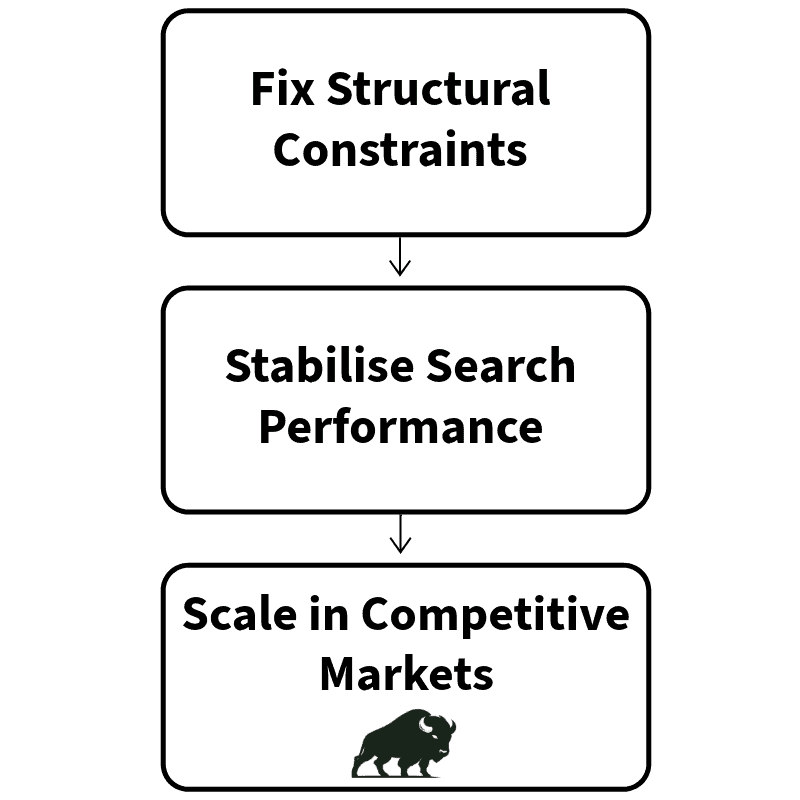
Our SEO approach follows a clear sequence: structural issues are corrected first, search performance is stabilised next, and only then is growth expanded into competitive markets.
How We Stabilise Search Performance Before Scaling
Stability in SEO means rankings hold their position and visibility behaves in a predictable way over time.
Changes made to a site lead to results that can be understood and sustained.
In competitive markets, this state needs to be established before growth is pursued. Without stability, expansion increases volatility rather than progress.
We stabilise performance by reinforcing what a site already communicates well.
Core pages are defined clearly.
Supporting content exists to strengthen those pages rather than compete with them.
Internal links direct importance toward priority areas.
This alignment allows search engines to interpret the site consistently, even as competitors and conditions change.
Consistency plays a central role.
Structure, content, and authority all need to support the same intent. When these elements stay aligned, rankings begin to settle. When they drift apart, interpretation becomes unstable.
Stability is created through reinforcement and coherence, not reactive change.
Control over how changes are introduced also matters. Updates are made gradually and with a clear purpose. Each adjustment builds on the last.
This sequencing reduces disruption and allows performance to develop in a steady, trackable way.
For businesses based in and around Bristol and competing in demanding search environments, this is often the turning point.
Rankings stop shifting without explanation.
Performance becomes easier to interpret.
Results become dependable rather than erratic.
Stability doesn’t just improve outcomes. It makes search performance manageable.
Once this foundation is established, growth becomes reliable. New content strengthens what is already performing well. Expansion reinforces relevance. Scale becomes the natural next step rather than a risk.
What does “stability” in SEO actually mean?
Stability means rankings remain settled, traffic follows clear patterns, and improvements hold over time. Performance behaves consistently rather than fluctuating unpredictably.
How do you prevent rankings from fluctuating?
By aligning content, structure, and internal signals around clear priorities. Reinforcing what matters most keeps interpretation steady and rankings stable.
Scaling Organic Search in Competitive Markets
Scaling organic search becomes effective only after stability has been established.
In competitive markets, growth works when it extends performance that already behaves consistently. When visibility holds steady and changes lead to clear outcomes, organic search can expand without introducing instability.
Scaling is about compounding strength.
Pages that already perform well are deepened with content that strengthens their relevance.
Authority extends outward from trusted areas.
Internal links expand in a way that preserves clarity and supports priority topics.
This turns growth into reinforcement rather than disruption.
Controlled expansion also depends on sequencing.
New opportunities are evaluated for fit.
Topics are introduced gradually.
Each addition is judged by how well it supports what already exists.
This keeps interpretation clear as scope increases.
For businesses based in and around Bristol, scaling often means moving beyond local search. Once stability is proven, National SEO campaigns allow reach to grow while preserving the structure that made visibility reliable in the first place.
At this stage, performance progresses in measurable steps.
Rankings improve with continuity.
Traffic follows clear patterns.
Predictability comes from alignment rather than speed.
In competitive search, scale is the deliberate extension of a system that already holds under pressure.
When does SEO become predictable?
SEO becomes predictable once stability is in place. Rankings remain settled, signals stay aligned, and changes produce consistent outcomes. Structure and control make performance manageable.
SEO Services in Bristol and Nationwide
Our SEO services are applied based on context rather than standard packages.
The level of competition, the scope of visibility required, and the commercial role organic search plays determine how each engagement is structured.
This ensures SEO remains effective whether a business operates within a single local market or competes across broader search environments.
For businesses focused on a defined area, SEO is shaped by local competition density and geographic intent. As reach expands, the demands on structure, relevance, and authority increase.
By scoping SEO services around context, performance remains reliable as visibility grows.
Local work restores clarity and control.
Broader campaigns extend that clarity into larger markets without introducing instability.
Each SEO engagement is shaped by where the business operates and how reliable search performance needs to be.
Local SEO Services
Local SEO services apply when visibility is required within a contained geographic area and competition is concentrated. The focus is on ensuring services and locations are interpreted clearly in local search results. This includes reinforcing priority pages, resolving overlap between similar intent, and aligning content with how people search locally.
In competitive cities, local SEO often centres on correction and stabilisation.
The objective is to restore clarity so visibility holds as competitors adjust and local results fluctuate.
This work is typically delivered as a contained engagement designed to resolve specific constraints rather than ongoing activity without a defined purpose.
Learn about CoolBison’s Local SEO services
Is local SEO different in competitive cities?
Yes. In competitive cities, more businesses target the same local intent. This increases the importance of clear structure, accurate prioritisation, and consistent local signals. Small differences in relevance and clarity have a greater impact on visibility than in less contested areas.
National & Competitive SEO Campaigns
National and competitive SEO campaigns apply when visibility is required across broader markets with established competitors. These environments involve higher authority thresholds, wider intent variation, and stronger reinforcement requirements.
Performance depends on how well the relevance built in Bristol’s competitive landscape holds as visibility extends into broader search environments.
For businesses already ranking in Bristol, national campaigns expand the visibility already earned, reinforcing what works locally while introducing relevance to new markets.
Stable pages are expanded into related areas.
Supporting content deepens coverage without fragmenting focus.
Internal structure is designed so authority flows consistently as reach grows, allowing visibility to develop in a controlled and predictable way.
International SEO Campaigns
International SEO campaigns apply when visibility needs to operate across multiple countries, languages, or regions.
Each market introduces distinct user behaviour, intent patterns, and competitive conditions.
Performance depends on maintaining consistency while allowing for regional accuracy.
International SEO focuses on organising content, structure, and internal links so each market is understood clearly without overlap or confusion.
Core themes are reinforced across markets, while regional content reflects local context.
Architecture and internal connections remain coherent as complexity increases, allowing visibility to grow across regions without dilution.
Learn about CoolBison’s International SEO campaigns

Why Businesses Choose CoolBison
Businesses choose CoolBison for focused SEO delivery built on experience, specialist leadership, and controlled execution.
Our work is designed for environments where organic search needs to perform reliably under competitive pressure, not fluctuate based on short-term activity.
SEO delivery is led by Marcus Rockey, a senior SEO specialist with experience in competitive search markets.
Strategy and execution remain closely aligned, ensuring decisions are made with a clear understanding of how structure, relevance, and authority affect long-term performance.
This leadership model reduces fragmentation and keeps SEO work grounded in outcomes rather than process.
We work exclusively in SEO.
This allows full attention to diagnosing what limits search performance and applying corrective work without competing service priorities.
Every engagement is shaped around how organic search needs to function as a dependable commercial channel.
All delivery is handled in-house, with full stack development and content capability supporting implementation.
Work is not outsourced or passed between external suppliers.
This ensures changes are applied accurately and consistently, reducing misinterpretation and execution risk.
Client numbers are deliberately capped.
This allows each engagement to receive the depth of analysis and care required in competitive markets.
Communication remains direct, decisions are deliberate, and progress is managed with long-term stability in mind.
For businesses operating in and around Bristol, this operating model provides clarity and confidence.
SEO work is transparent, controlled, and built to hold as competition intensifies.
Complete the form below
We will review the information you provide and get back to you shorlty.